


Wire Rope Inspection for Aerial Tramways and Ski Lifts
Updated: Jun 17
A Technical Guide to Rope Types, Splice Inspection, MFL Testing, and Acceptance Criteria Thomas R. Hay, PhD., P.E.

Wire Ropes in Aerial Tramways and Ski Lifts — Types and Applications
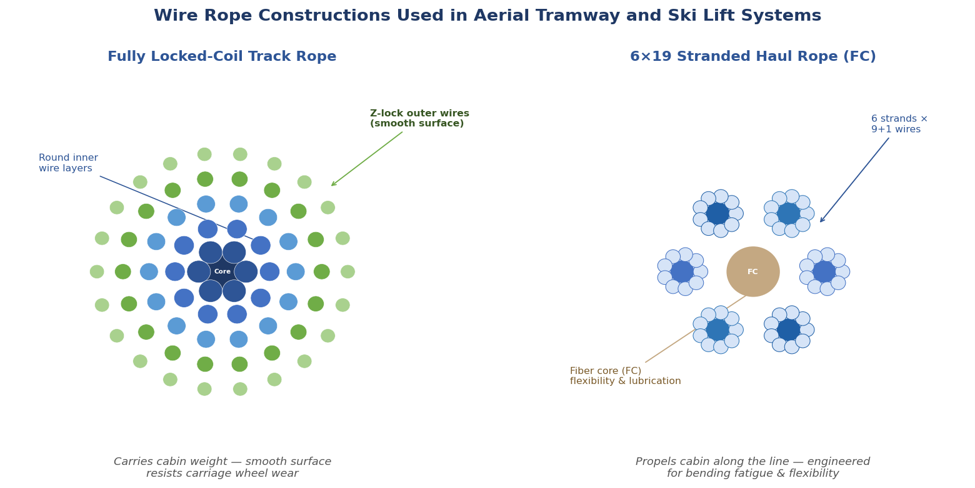
Aerial tramways, gondolas, chairlifts, and detachable ski lift systems rely on steel wire ropes to transport passengers safely across mountainous terrain and steep vertical changes. The ropes used in these systems are among the most safety-critical in any transportation application, subject to stringent international standards, mandatory inspection regimes, and strict discard criteria enforced by national ropeway authorities. Wire ropes in passenger ropeway systems are broadly divided into track ropes, haul ropes, and tensioning ropes, each serving a distinct mechanical function and requiring a specific rope construction to perform reliably throughout its service life.
Track ropes, also called carrying ropes or load-bearing ropes, support the weight of the carrier cabin or chair as it traverses the span between towers. These ropes are almost universally constructed as locked-coil or fully locked-coil wire ropes, featuring interlocking Z-shaped outer wires that create a smooth, closed surface. This construction provides exceptional stiffness, resistance to lateral deformation, and a hard-wearing surface that can withstand the repeated contact of carrier wheel assemblies over millions of cycles. Locked-coil track ropes are manufactured from high-strength galvanized or stainless-steel wires to resist corrosion from alpine weather exposure.
Haul ropes propel the carriers along the track and are continuously in motion during ropeway operation. In monocable systems, a single endless haul rope both supports and moves the carriers. In bicable tramways, separate track and haul ropes perform these functions independently. Haul ropes are predominantly stranded constructions, commonly six-strand or eight-strand with fiber or steel cores, engineered for high flexibility and fatigue resistance as they repeatedly bend over drive wheels, return wheels, and line sheaves at each tower. Rope selection is governed by EN 12927, ISO 12076, and the applicable national ropeway regulations of the country of installation.
Visual Inspection, Splice Inspection, and MFL Testing of Ropeway Ropes
Inspection of passenger ropeway ropes is a legal obligation in virtually every jurisdiction where aerial tramways and ski lifts operate, with inspection frequency, methodology, and documentation requirements defined by national ropeway regulations and international standards including the EN 12927 series and ISO 12076. Inspection programs combine mandatory visual examination performed by certified ropeway inspectors with electromagnetic non-destructive testing, principally Magnetic Flux Leakage (MFL) testing, to provide complete assessment of rope condition across both the accessible exterior surface and the inaccessible interior wire structure.
Visual inspection of ropeway ropes is conducted at defined intervals, typically daily for haul ropes during the operating season and at scheduled annual or biennial intervals for track ropes. Inspectors examine the full rope length for broken wires, corrosion, abrasion, strand protrusion, birdcaging, kinking, crushing, and localized diameter changes. Particular attention is directed to rope sections passing over sheave wheels at towers, the termination zones at anchor sockets and splices, and any areas exposed to chemical contamination, mechanical impact, or ice loading. Modern visual inspection practice increasingly incorporates digital cameras, structured light scanners, and UAV-mounted imaging to improve coverage of difficult-to-access rope sections.
Haul Rope Splice Inspection
The splice is one of the most critical zones of an endless haul rope and demands dedicated inspection attention beyond the routine rope body examination. Endless haul ropes used in chairlifts, gondolas, and monocable systems are formed into a continuous loop by means of a long splice, in which the strands of the two rope ends are progressively tucked into one another over a splice length that can reach several meters depending on rope diameter and the splicing standard applied. This gradual taper is designed to distribute the load transfer smoothly across the splice zone and to minimize the bending stiffness discontinuity as the splice passes over drive and return wheels.
Visual inspection of the haul rope splice covers the full splice length and focuses on detecting broken outer wires at the tuck points, fretting between tucked strands, corrosion within the splice interior where lubricant penetration is limited, distortion or protrusion of tucked strand ends, and any diameter irregularities along the splice taper. Because the splice involves multiple strand tuck points at relatively short intervals, wire breaks and fatigue cracks tend to concentrate at these locations under the cyclic bending loads imposed by sheave wheels, making the splice statistically the highest-risk zone for wire break accumulation in the haul rope. Inspectors mark and record the splice location precisely so that its position can be correlated with MFL data during electromagnetic inspection and tracked consistently across successive inspection cycles.
Magnetic Flux Leakage (MFL) testing provides the most reliable method for comprehensive splice condition assessment, detecting internal wire breaks, fretting damage, and corrosion within the splice body that are not accessible to visual examination. The splice presents a characteristic MFL signal signature that differs from the rope body due to the increased metallic cross-sectional area at the strand tuck overlaps and the geometric complexity of the interlocked strand ends. An experienced MFL interpreter establishes a baseline splice signature during initial rope inspection and uses this reference to identify anomalous signal changes in subsequent inspections that indicate developing deterioration. Increases in LF signal amplitude at the tuck point locations, changes in the symmetry of the splice signature, or a reduction in the LMA baseline through the splice zone compared to earlier records are all indicators that warrant closer engineering assessment of the splice condition. Because MFL instruments traverse the splice at the same speed as the rope body, a complete quantitative record of splice condition is captured in every inspection pass, enabling the rate of deterioration within the splice to be tracked with a precision that visual inspection alone cannot provide.

The combined visual and MFL inspection approach applied to the splice mirrors the broader rope inspection philosophy: visual examination provides immediate identification of surface wire breaks and external deterioration at the tuck points, while MFL quantifies internal damage and overall metallic area trends across the full splice length. Together, these methods provide the complete splice condition picture required by EN 12927 and supporting national ropeway regulations, and they form the documented evidence base for splice acceptance decisions at annual and mid-season inspections.
Acceptance and Rejection Criteria for Aerial Tramway and Ski Lift Ropes
Acceptance and rejection criteria for passenger ropeway ropes are among the most stringent of any wire rope application, reflecting the direct risk to public safety. The governing standards are the EN 12927 series (Safety Requirements for Cableway Installations Designed to Carry Persons — Ropes), ISO 12076 (Steel Wire Ropes — Inspection and Discard), and applicable national ropeway regulations, which in many countries incorporate EN 12927 directly or establish equivalent or more conservative requirements.
For the rope body, haul ropes are typically discard-rated when as few as two broken wires are detected within a single lay length — significantly more conservative than industrial crane standards. Track ropes have broken wire limits per reference length based on rope diameter and construction. Any birdcaging, kinking, strand displacement, or evidence of torsional instability is treated as an immediate discard condition. Corrosion is assessed using standardized grading scales, and ropes exhibiting category 3 or 4 pitting corrosion are typically removed from service. Diameter reductions exceeding approximately 5% of nominal at any cross-section are grounds for engineering review and often rejection.
Splice-specific acceptance criteria impose additional requirements beyond those applied to the rope body.
The number of broken wires permitted within the splice zone is typically lower than the rope body limit, reflecting the stress concentration effect of the tuck geometry and the higher fatigue loading experienced at sheave contact zones. Many ropeway operators and national regulations specify that any broken wire detected within a defined distance of a splice tuck point — commonly one lay length either side — triggers immediate engineering review regardless of the total broken wire count. MFL LF indications concentrated within the splice zone are assessed against more conservative thresholds than equivalent signals in the rope body, with any new or growing LF anomaly at a tuck point location documented and evaluated against the previous inspection baseline before the rope is returned to service. LMA discard thresholds for ropeway ropes are generally set at 8–10%, with alarm thresholds at 3–5% prompting increased inspection frequency. The documented splice MFL baseline established at commissioning or first inspection is an essential reference for all subsequent condition assessments and must be retained as part of the rope service record for the full operational life of the rope.
References
1. European Committee for Standardization (CEN). EN 12927 Series, Safety Requirements for Cableway Installations Designed to Carry Persons — Ropes. Brussels: CEN.
2. International Organization for Standardization (ISO). ISO 12076:2002, Steel Wire Ropes — Inspection and Discard. Geneva: ISO.
3. International Organization for Standardization (ISO). ISO 4309:2017, Cranes — Wire Ropes — Care and Maintenance, Inspection and Discard. Geneva: ISO.
4. Feyrer, K. Wire Ropes: Tension, Endurance, Reliability. 2nd ed. Berlin: Springer, 2015.
5. Chaplin, C.R. Failure Mechanisms in Wire Ropes. Engineering Failure Analysis, 2(1), 45–57, 1995.
6. Kmet, S., and Mojdis, M. Time-Dependent Analysis of Cable Nets Using a Modified Force Density Method. Engineering Structures, 148, 168–180, 2017.


This page covers a specific fighting game adaptation from the mid-90s, distinguishing it from other entries in the series. The description points out the Neo Geo origins and the unique transformation mechanics, which gives context for what makes this version stand out. It's a useful reference for anyone tracking the various iterations of this franchise. The 1995 fighter adaptation is detailed clearly enough to inform a quick decision.