


FRP (Fiberglass Reinforced Plastic) Tank Installation and PADEP AMNX Installation and Inspection Compliance: Technical, Regulatory, and Certification Considerations
1. Introduction
Fiberglass Reinforced Plastic (FRP) tanks are widely used in water and wastewater treatment facilities for chemical storage due to their excellent corrosion resistance, favorable strength-to-weight ratio, and long service life when properly designed, fabricated, and installed. FRP tanks are commonly selected for oxidizing chemical service, including chlorine dioxide, hypochlorite, and other aggressive treatment chemicals.
Despite their advantages, FRP tanks are highly sensitive to installation conditions. Improper handling, inadequate foundations, poorly designed anchorage, misaligned piping, or insufficient inspection can negate the benefits of quality fabrication and lead to premature failure, leakage, or structural distress. Because these failures may result in releases of regulated substances, FRP tank installations in Pennsylvania are subject to regulatory oversight by the Pennsylvania Department of Environmental Protection (PADEP).
When FRP tank installations fall under PADEP AMNX (Aboveground Manufactured Non-Metallic – New Installation or Modification) review, the Department evaluates not only the technical design and installation details, but also the qualifications of the installing company and the certifications of inspectors performing required inspections and testing. This article summarizes the technical considerations for FRP tank installation and explains the environmental policy and regulatory basis for PADEP’s AMNX inspection and certification requirements.

2. Pre-Installation Planning and Coordination of FRP tank installation
Successful FRP tank installation begins well before delivery to the site. All installation activities must be coordinated among the tank manufacturer, contractor, engineer of record, and owner. Shop drawings, design calculations, and installation procedures must be reviewed and approved prior to fabrication and delivery. These documents define tank dimensions, nozzle orientations, anchorage requirements, material compatibility, and testing protocols.
Applicable standards typically include:
ASTM D3299 and ASTM D4097 for FRP tank construction
ASTM E1067 for acoustic emission (AE) testing
International Building Code (IBC) and ASCE 7 for wind and seismic loading
ASME RTP-1 is the premier standard for design, fabrication, and inspection of fiberglass-reinforced plastic (FRP) vessels.
Design calculations should be sealed by a licensed professional engineer with experience in FRP structures and site-specific loading conditions. Under PADEP AMNX review, these documents form part of the technical basis for determining whether the proposed installation adequately protects environmental resources. Important design considerations include the minimum required shell thickness to support the tank hydrostatic load. In accordance with ASTM D3299, the minimum thickness due to hydrostatic load, is calculated using


3. Handling, Transportation, and Storage
FRP tanks are structurally robust in service but comparatively vulnerable during handling and transportation. Tanks must be shipped in properly designed cradles with padded supports to prevent point loading or distortion. Chains or rigid restraints must not be placed in contact with tank surfaces; woven nylon or fabric straps are required.
Upon delivery, tanks must be inspected for cracks, crazing, delamination, or damage to nozzles, lifting lugs, and laminates. Any damage must be documented and resolved prior to acceptance. Tanks should be stored on level supports, protected from impact, excessive heat, and prolonged ultraviolet exposure.
Lifting operations are critical. Only manufacturer-approved lifting lugs or sling locations may be used. Slings must be wide, soft, and oriented to maintain near-vertical lifting angles, typically requiring a spreader bar. Slings must never contact nozzles, flanges, or gussets, as these components are not designed for handling loads.
4. Foundation and Support Requirements
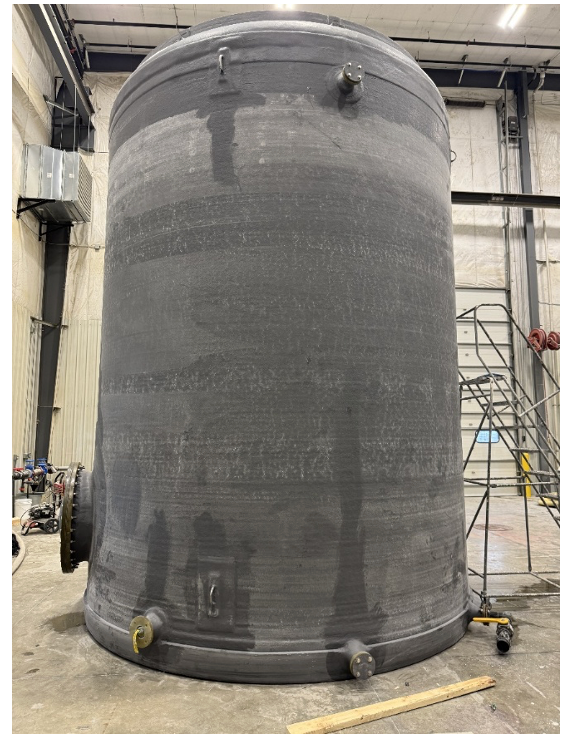
The foundation is one of the most critical elements of FRP tank installation. FRP tanks rely on uniform bottom support and are highly sensitive to point loads. Concrete pads must be level, smooth, and free of surface irregularities. Slopes, high spots, or embedded debris can create localized stress concentrations that may lead to bottom cracking or laminate failure.
A continuous elastomeric isolation mat, commonly 3/8-inch EPDM, is typically installed between the tank bottom and the concrete pad. This mat accommodates minor imperfections, reduces stress concentrations, and provides limited vibration isolation. Tanks must be installed plumb and level to prevent uneven hydrostatic loading.

Drain notches, containment curbs, and pad geometry must be verified for compatibility with tank outlets and anchor locations prior to setting the tank.

5. Anchorage, Wind, and Seismic Restraint
FRP tanks are lightweight compared to steel or concrete tanks and are therefore susceptible to uplift and overturning due to wind, seismic, or buoyancy forces. Proper anchorage is essential, including for tanks installed indoors or within containment areas.
Anchorage systems typically consist of manufacturer-designed FRP or stainless-steel tie-down lugs combined with contractor-installed anchor bolts embedded in concrete. Anchor type, diameter, embedment depth, spacing, and edge distance must comply with engineered calculations and governing codes. Where existing pads limit edge distances, the condition must be reviewed and approved by the engineer of record.
Anchors must resist shear, tension, and combined loading under governing wind and seismic conditions. Improper anchorage can result in sliding, uplift, or progressive shell damage during seismic events, increasing the risk of chemical release. Simpson Strong-Tie Anchor Designer for Concrete software may be used to simulate loads and geometry satisfy the strength design provisions of ACI 318, ASCE 41-17, CSA A23.3, EN 1992-4, ETAG, or EOTA design methodologies (Anchor Designer for Concrete | Simpson Strong-Tie).

6. Piping Connections and Load Isolation
One of the most common causes of FRP tank damage is improper piping support. FRP tanks are not designed to carry external piping loads. All connected piping must be independently supported so that dead loads, thermal expansion forces, and vibration are not transmitted to tank nozzles.
Flexible connectors are often recommended at inlet, outlet, and drain connections to accommodate differential movement between the tank and piping systems. Piping alignment must be precise; forced alignment can introduce stresses that cause nozzle cracking or laminate delamination.
Flanged connections must use flat-face flanges with compatible gaskets and manufacturer-specified bolt torque. Over-torquing can crush FRP flanges, while under-torquing can result in leakage.

7. Installation of Appurtenances and Accessories
FRP tanks commonly include manways, ladders, handrails, level instruments, sight gauges, vents, and overflow piping. These components must be installed exactly as shown on approved drawings and should be verified by a PADEP AMNX inspector.
External ladders and handrails must comply with OSHA requirements and be fabricated from corrosion-resistant materials compatible with the chemical environment. All field-drilled holes, cut edges, or attachments must be sealed with compatible resin systems to prevent moisture intrusion and laminate degradation.
Instrumentation penetrations must be coordinated with instrument suppliers to ensure proper clearances, mounting elevations, and maintenance access.
8. Inspection and Field Testing
Quality assurance does not end at fabrication. Field inspection and testing are essential to verify that the tank has not been damaged during transport or installation.
After installation and prior to piping connection, tanks typically undergo a hydrostatic leak test. The tank is filled with water to the maximum operating level and held for a specified duration to verify watertight integrity.
Many specifications and regulatory reviewers require Acoustic Emission (AE) testing in accordance with ASTM E1067 following hydrostatic testing. AE testing identifies active defects and establishes a baseline for future condition monitoring. Industry experience has demonstrated that FRP tanks passing AE testing have a significantly reduced likelihood of early-life failure.

9. PADEP AMNX Regulatory and Environmental Policy Basis
9.1 Statutory Authority
PADEP’s authority to regulate FRP tank installations derives primarily from the Storage Tank and Spill Prevention Act (Act 32 of 1989). The Act was enacted to prevent releases of regulated substances and to protect soil, groundwater, surface water, and public health. The legislature recognized that releases from storage tanks pose significant environmental risks and are often costly and difficult to remediate.
Under Act 32, PADEP is authorized to regulate the installation, modification, inspection, and operation of storage tank systems to prevent environmental contamination.
9.2 Certification Requirements and PADEP AMNX
PADEP regulations implementing Act 32 (25 Pa. Code Chapter 245) establish certification requirements for storage tank installers and inspectors. These regulations include certification categories for Aboveground Manufactured Non-Metallic (AMNX) tank systems, which encompass FRP and other non-metallic tanks.
Under these regulations:
Only PADEP-certified installers and inspectors may perform regulated installation, modification, or inspection activities
Certification ensures personnel are trained and tested on applicable regulations, environmental protection requirements, and technical standards
Inspections must be performed by qualified individuals capable of independently verifying compliance
These requirements apply to new installations, major modifications, and certain relocations of FRP tank systems. PADEP’s AMNX inspection and certification requirements serve several environmental protection objectives:
Prevention of releases through competent installation and verification
Independent confirmation that tanks are installed in accordance with approved designs and standards
Reduction of regulatory risk associated with chemical storage failures
Protection of water resources, soil, and public health
Because FRP tanks are sensitive to installation errors, PADEP places emphasis on verified competency and documented compliance to ensure long-term environmental protection.
Upon completion of installation and testing, the manufacturer’s representative should certify that the tank has been installed in accordance with manufacturer requirements. All inspection reports, test results, certifications, warranties, and as-built documentation must be compiled and retained.
Routine inspection and maintenance are essential for long-term performance. Interior and exterior surfaces should be periodically inspected for corrosion, discoloration, cracking, or softening. Retention of baseline inspection data, including AE test results where applicable, supports future condition assessments and regulatory defensibility.
11. Conclusion
FRP tanks provide reliable, long-term service in water and wastewater treatment applications when properly installed and inspected. However, their performance is highly dependent on handling practices, foundation quality, anchorage design, piping isolation, and inspection rigor.
PADEP’s AMNX requirements are grounded in statutory authority and environmental policy aimed at preventing releases of regulated substances and protecting public health and the environment. By integrating sound engineering practices with certified installers, qualified inspectors, and thorough documentation, owners and contractors can achieve regulatory compliance, reduce environmental risk, and ensure the long-term integrity of FRP tank systems.
12. References
A. Technical Standards and Industry References
ASTM D3299 – Standard Specification for Filament-Wound Glass-Fiber-Reinforced Thermoset Resin Chemical-Resistant Tanks ASTM International.
ASTM D4097 – Standard Specification for Contact-Molded Glass-Fiber-Reinforced Thermoset Resin Chemical-Resistant Tanks ASTM International.
ASTM E1067 – Standard Practice for Acoustic Emission Examination of Fiberglass Reinforced Plastic Resin (FRP) Tanks/Vessels ASTM International.
API SPECIFICATION 12P, Specification for Fiberglass Reinforced Plastic Tanks FIFTH EDITION, MAY 2022
ASTM D2563 – Standard Practice for Classifying Visual Defects in Glass-Reinforced Plastic Laminate Parts ASTM International.
ASTM D2583 – Standard Test Method for Indentation Hardness of Rigid Plastics by Means of a Barcol Impressor ASTM International.
ASME RTP-1 – Reinforced Thermoset Plastic Corrosion Resistant Equipment
American Society of Mechanical Engineers.
International Building Code (IBC) – Current adopted edition by the Commonwealth of Pennsylvania.
Storage Tank and Spill Prevention Act (Act 32 of 1989)
Pennsylvania Consolidated Statutes, Act of July 6, 1989, P.L. 169, No. 32.
25 Pa. Code Chapter 245 – Administration of the Storage Tank and Spill Prevention Program Pennsylvania Department of Environmental Protection (PADEP).


Installing underground composite vessels leaves practically zero margin for error, particularly under stringent environmental inspection codes. Reliable material delivery is crucial throughout the timeline, since recurring inventory discrepancies reported through https://lowes.pissedconsumer.com/review.html can delay specialized hardware shipments and hold up entire field crews on site. Strict adherence to state testing protocols guarantees long-term structural integrity and protects against costly environmental leaks down the road.