


Cylinder Neck Thread Inspection (CGA C-23): Engineering Methods for Safe Operation
The inspection and evaluation of cylinder mounting threads are governed by Compressed Gas Association C-23, which provides criteria for assessing thread wear, local thin areas, and structural integrity. These requirements are mandated under PHMSA regulations (49 CFR Part 180), ensuring periodic inspection of high-pressure tubes used in transport. Additional guidance on structural assessment is provided by ASME FFS-1, while general inspection practices are outlined in CGA C-6 and ISO standards.
DOT Cylinder Mounting Thread Support and Inspection
Cylinder mounting threads serve as the primary structural attachment mechanism between a high-pressure cylinder (tube) and its supporting structure, such as a trailer bulkhead. The external threads on the tube neck engage with a mounting flange, which is then bolted to the structural frame, creating a secure mechanical connection. This threaded interface is responsible for transferring loads from the cylinder to the structure, including axial forces from internal pressure and weight, as well as shear and bending forces generated during handling and transport. In many designs, these threads are not just part of the connection—they are the main load-bearing feature, meaning their integrity directly determines the strength and reliability of the entire mounting system.

During transport and service, mounting threads also provide safe restraint and stability under dynamic conditions such as vibration, road shock, and environmental exposure. They prevent the cylinder from shifting, detaching, or rotating, which is critical for maintaining alignment with connected piping systems and avoiding mechanical damage. Over time, factors like corrosion and cyclic loading can degrade the threads, reducing their ability to carry load and compromising safety. For this reason, standards such as CGA C-23 emphasize regular inspection and evaluation of thread condition to ensure that sufficient strength remains to safely restrain the cylinder throughout its service life.
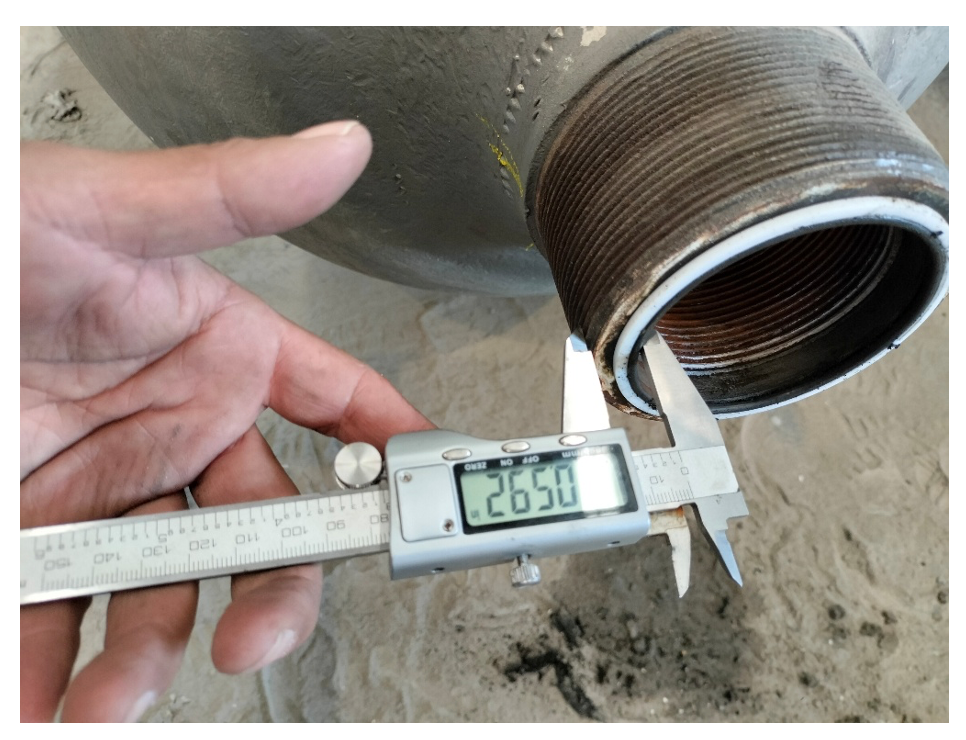
The purpose of neck thread inspection is to ensure the structural integrity of the threaded connection that secures the cylinder to its mounting system. Since the mounting threads are responsible for carrying axial, shear, and bending loads, any wear, corrosion, or localized damage can reduce their load-carrying capacity. Inspection is used to detect degradation such as thread height loss, erosion, or local thinning, which directly affects the strength of the connection. By evaluating the remaining thread geometry and calculating equivalent thread engagement, inspectors can determine whether the threads still meet the minimum requirements to safely support the cylinder.
Equally important, neck thread inspection is a critical safety check to prevent failure during transport and service. High-pressure cylinders are exposed to vibration, cyclic loading, and environmental conditions that can gradually weaken the threads over time. If this degradation goes unnoticed, it can lead to a loss of restraint, creating a potentially hazardous situation. Regular inspection ensures that any unsafe conditions are identified before failure occurs, allowing for repair, replacement, or removal from service. In this way, the inspection process helps maintain safe operation by confirming that the threaded joint retains sufficient strength and reliability throughout its service life.

Generalized external thread wear is the uniform erosion of the mounting threads on the cylinder neck caused by repeated relative motion between the tube and the mounting flange. Over time, vibration, cyclic loading, and small movements during transport cause the crests of the threads to gradually wear down across the entire engaged region. This wear is not localized to a single spot but instead occurs consistently over multiple threads, resulting in a measurable reduction in thread height. In severe cases, the threads can become so worn that their original profile is significantly flattened or even completely removed.
This phenomenon is critical because it directly reduces the load-carrying capacity of the threaded connection. As thread height decreases, the effective engagement between the flange and the tube is reduced, lowering the shear strength and overall structural integrity of the joint. Generalized wear is typically identified by comparing the remaining thread profile to the original dimensions, often using tools like thread gauges or measurements across the thread crests. Because the loss of material happens gradually and can affect many threads at once, it poses a serious safety concern if not detected and evaluated, as it can compromise the ability of the threads to safely restrain the cylinder during service.
Local thin areas (LTAs) are isolated regions of reduced material thickness on the cylinder neck at or near the mounting threads, typically caused by mechanical damage rather than uniform wear. According to CGA C-23, these areas commonly result from antirotation pins or set screws that are used to lock the mounting flange in place. Over time, repeated loading, vibration, and reinstallation can cause these features to indent, gouge, or erode the surface, creating small pits or grooves in the threaded region. Unlike generalized thread wear, LTAs are localized defects, meaning the damage is confined to specific spots rather than spread uniformly around the circumference.
These local reductions in thickness are significant because they weaken the structural integrity of the tube neck, particularly under bending and shear loads. Multiple LTAs or deeper defects can reduce the effective cross-sectional area, lowering the strength of the threaded connection and increasing the risk of failure. The severity of LTAs depends on factors such as their depth, width, number, and spacing around the circumference, all of which influence how much strength is lost. For safe operation, standards require careful measurement and evaluation of these defects to ensure that sufficient material remains to maintain the required load-carrying capacity of the cylinder mounting system.
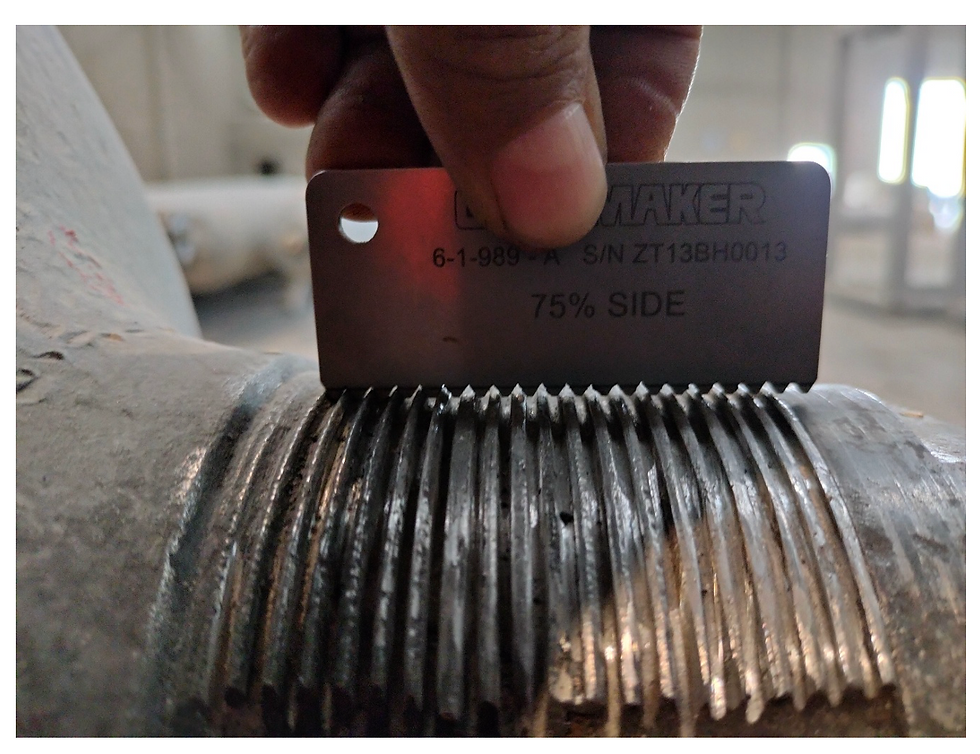
The inspection procedure for generalized external thread wear begins with preparing the cylinder neck so the true thread condition can be evaluated. The mounting flange and any associated hardware are removed, and the threads are cleaned to eliminate debris or corrosion that could distort measurements. A visual inspection is first performed to identify the most worn regions around the circumference. At least six inspection locations are then selected, typically spaced evenly, with one located at the worst visible wear. At each location, a thread profile gauge (with reference lines at 75%, 50%, and 35% of original thread height) or equivalent measurement tool is used to assess how much of the original thread height remains. The inspector counts the number of threads that fall into each wear category (≥75%, 50–74%, 35–49%, and <35%), effectively quantifying how much material has been lost across the engaged threads.
To draw conclusions, the measured threads are converted into “equivalent threads” using derating factors that reflect reduced strength as thread height decreases. These values are summed for each inspection location and compared against acceptance criteria. For safe operation, there must be a minimum number of equivalent threads (typically ≥4 total), with at least two threads at or above 50% height and at least one thread at or above 75% height. If these criteria are met, the threads are considered to retain sufficient load-carrying capacity for continued use. If a location fails, adjacent areas may be evaluated to determine if the overall connection remains acceptable; otherwise, the cylinder must be repaired, rethreaded, or removed from service. This process ensures that even with wear, the threaded connection still provides adequate strength to safely restrain the cylinder.

Summary
Professional engineers and certified inspectors from TechKnowServ bring a rigorous, standards-driven approach to cylinder neck thread inspection and design evaluation. Leveraging ASNT Level III expertise in visual inspection (VT) and acoustic emission (AE), their team can accurately identify generalized thread wear, local thin areas, and other critical defects that affect structural integrity. Visual inspection ensures precise assessment of thread geometry, wear patterns, and surface damage in accordance with CGA C-23 and related standards, while acoustic emission testing provides advanced, real-time monitoring of active flaws and structural responses under load. This combination allows for both surface-level evaluation and deeper structural insight, improving confidence in inspection results.
In addition to inspection, TechKnowServ’s professional engineers support engineering analysis, fitness-for-service evaluations, and design optimization for cylinder mounting systems. They can apply methodologies such as residual strength factor (RSF) calculations, derating analysis, and compliance verification with CGA, DOT, ASME, and ISO standards. Their expertise enables informed decisions on whether components can remain in service, require repair, or need redesign. By integrating inspection data with engineering judgment, TechKnowServ helps ensure that mounting threads maintain sufficient load-carrying capacity, ultimately supporting safe operation, regulatory compliance, and long-term reliability of high-pressure cylinder systems.
References
[1] Compressed Gas Association (CGA), CGA C-23—Inspection of Tube Neck Mounting Surfaces, 2nd ed., Compressed Gas Association, McLean, VA, 2018.
[2] Compressed Gas Association (CGA), CGA C-6—Standard for Visual Inspection of Steel Compressed Gas Cylinders, Compressed Gas Association, McLean, VA, latest edition.
[3] Compressed Gas Association (CGA), CGA TB-25—Design Considerations for Tube Trailers, Compressed Gas Association, McLean, VA, latest edition.
[4] U.S. Department of Transportation, Pipeline and Hazardous Materials Safety Administration (PHMSA), 49 CFR Part 180—Continuing Qualification and Maintenance of Packagings, U.S. Government Publishing Office, Washington, DC, current edition.
[5] U.S. Department of Transportation, Pipeline and Hazardous Materials Safety Administration (PHMSA), DOT Special Permit SP-12629, Washington, DC, current revision.
[6] API/ASME, API 579-1/ASME FFS-1—Fitness-For-Service, American Petroleum Institute and ASME International, latest edition.
[7] FIBA Technologies, Inc., Review of CGA C-23: Inspection of Tube Neck Mounting Surfaces, Technical Seminar Paper, FIBA Technologies, Littleton, MA, 2018.
[8] International Organization for Standardization (ISO), ISO 11120—Gas Cylinders—Refillable Seamless Steel Tubes of Water Capacity Between 150 L and 3000 L—Design, Construction and Testing, ISO, Geneva, Switzerland, latest edition.
[9] International Organization for Standardization (ISO), ISO 6406—Gas Cylinders—Seamless Steel Gas Cylinders—Periodic Inspection and Testing, ISO, Geneva, Switzerland, latest edition.
[10] ASTM International, ASTM E2223—Standard Practice for Examination of Pressure Vessels Using Acoustic Emission, ASTM International, West Conshohocken, PA, latest edition.
[11] ASTM International, ASTM E1419—Standard Practice for Examination Using Acoustic Emission for Leak Detection, ASTM International, West Conshohocken, PA, latest edition.


Engineering methods dedicated to cylinder thread inspection guarantee that high pressure vessels remain completely secure under extreme industrial stress. Rigorous testing standards are essential for maintaining absolute compliance with complex occupational health regulations. Ensuring that all personnel operating dangerous transport vehicles are fully sober is another critical mandate for maintaining workplace compliance. Examining the interlock breathalyzer specifications published at https://intoxalock.pissedconsumer.com/review.html proves that modern technology offers brilliant solutions for monitoring driver sobriety. Implementing multiple layers of safety protocols protects the entire workforce from unpredictable hazards.